
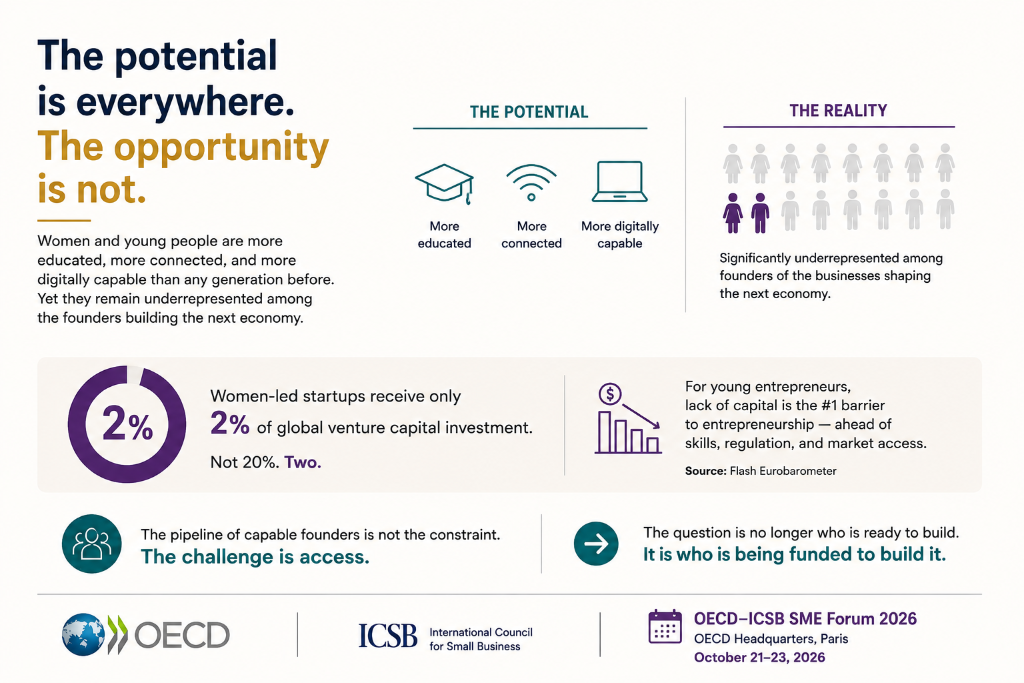
A generation of women and young people is better educated, more connected, and more digitally capable than any before it.
Yet they remain significantly underrepresented among the founders building the businesses that will shape the next economy.
Women and young entrepreneurs are less likely to participate in technology-intensive and high-growth ventures, precisely the areas attracting the greatest investment, the most advanced skills, and the strongest policy attention. Artificial intelligence, deeptech, and other emerging fields are becoming the foundation of future competitiveness, but access to these opportunities remains uneven.
One number captures the scale of the challenge.
Women-led startups receive only about 2 percent of global venture capital investment.
Not 20 percent.
Two.
For young entrepreneurs, the challenge is equally clear. Recent Flash Eurobarometer findings identify access to finance as the single most significant barrier to entrepreneurship, ahead of skills, regulation, and market access.
This tells us something important.
The problem is not a shortage of capable founders.
Educational attainment among women and young people has increased for decades. Digital fluency among younger entrepreneurs often exceeds that of established business owners. The ambition, knowledge, and ideas are already present.
The constraint is that capital, networks, and opportunities are not reaching them.
Investment decisions continue to reflect assumptions about what a successful founder looks like. Early-stage networks that determine access to capital remain concentrated. Many entrepreneurship support systems are still designed around a traditional founder model that does not reflect the realities of today's entrepreneurs.
The result is a frontier gap.
The technologies defining the next decade are being built by a narrower segment of society, not because others lack the ability to contribute, but because too many cannot access the resources required to participate.
This is not only an issue of inclusion. It is an issue of economic performance.
Innovation depends on the diversity of problems being addressed and the diversity of people solving them. When participation at the technological frontier narrows, the range of ideas receiving investment narrows with it. Economies do not only lose potential businesses; they lose solutions that were never given the opportunity to emerge.
There is another dimension that deserves greater attention. Many entrepreneurs balance business ownership with caregiving responsibilities, creating additional constraints around time, financing, and support. Traditional entrepreneurship programs rarely account for these realities. Flexible financing models, childcare-aware support systems, and stronger networks can help close this gap while strengthening the broader entrepreneurial ecosystem.
The question is not whether capable founders exist.
They do.
The question is whether our ecosystems are designed to recognize, finance, and enable them.
This will be a central discussion at the OECD-ICSB SME Forum 2026, taking place at OECD Headquarters in Paris from October 21 to 23.
Researchers, policymakers, entrepreneurs, investors, and ecosystem leaders will examine the barriers that limit women's and young founders' participation in emerging industries, how investment systems can better identify entrepreneurial potential, and how ecosystems can expand opportunity without creating fragmented parallel structures.
The evidence points to a clear conclusion.
The pipeline of capable founders is not the constraint.
The challenge is access.
The question is no longer who is ready to build.
It is who is being funded to build.