Entrepreneurship policy is built around beginnings.
Incubators. Seed funding. First-time founders. Startup visas. Accelerators. Nearly every instrument governments have designed focuses on the moment a business comes into existence.
But what happens after the business succeeds?
Family businesses account for a majority of businesses and jobs across many OECD economies. They are not a niche category or a sentimental footnote to the startup economy. In many places, they are the economy.
Yet entrepreneurship policy remains overwhelmingly focused on creating new firms rather than helping established ones survive one of the most consequential moments in their existence:
The handover from one generation to the next.
For many family businesses, the greatest threat is not starting.
It is transferring.
Across economies, family firms are approaching pivotal generational transitions. Founders are preparing the next generation for leadership. Ownership is moving from parents to children. And decades of knowledge (supplier relationships, technical expertise, customer understanding, and market judgment) must somehow move with it.
Much of that knowledge has never been written down.
When succession planning is weak, the consequences can be severe. A profitable company can lose direction. Employees can lose jobs. Relationships built over decades can disappear. Knowledge that existed in people rather than systems can vanish almost overnight.
A viable business can fail at the handover.
And when it does, an incubator, startup visa, or seed fund cannot save it.
But there is another side to this story.
Succession should not simply be about preservation. It can be a moment for reinvention.
A generational transition creates a rare opening for an established company to ask difficult questions.
What should remain?
What should change?
What does the next generation see that the previous generation could not?
And how can decades of accumulated experience be combined with new technologies, new markets, and new ways of doing business?
The objective should not be to hand the next generation a perfectly preserved version of yesterday's company. It should be to give them the foundation to build tomorrow's.
That requires us to think differently about intergenerational entrepreneurship.
Rather than treating older and younger generations as opposing forces (the founder who refuses to leave and the successor who wants to change everything), we should be asking how entrepreneurial ecosystems can help generations build together.
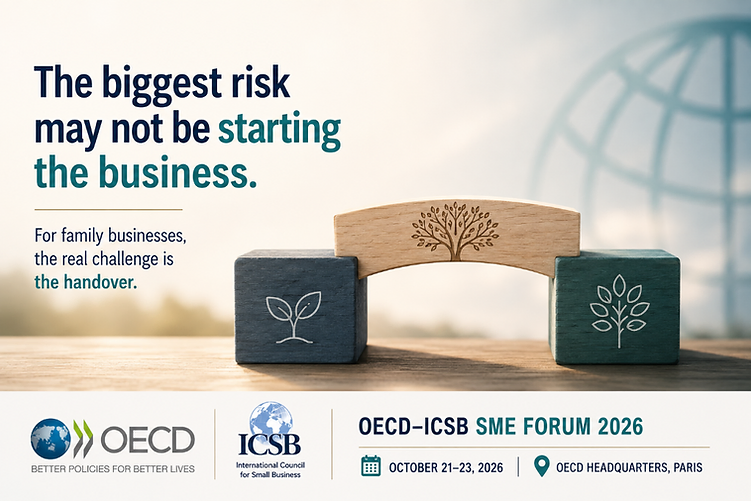
This is one of the questions we will examine at the OECD-ICSB SME World Forum 2026, at OECD Headquarters in Paris, October 21-23.
A forward-looking roundtable will bring together researchers, policymakers, entrepreneurs, and business leaders to examine what intergenerational entrepreneurship looks like in practice: how ecosystems can support younger and older generations working together, which approaches to succession actually work, and how family businesses can use leadership transitions to renew rather than simply preserve.
The conclusion is not that startup policy is wrong.
It is that it is incomplete.
We have spent decades building an entrepreneurship policy for the first generation.
But much of the economy is already in the hands of the second, the third, and the fourth.
Perhaps the next frontier of entrepreneurship policy is not simply helping more businesses begin.
It is helping successful businesses begin again.