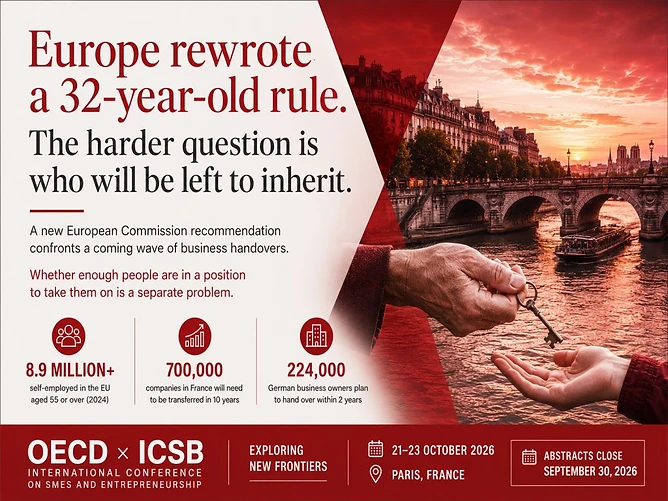
A new European Commission recommendation confronts a coming wave of business handovers. Whether there is anyone in a position to take them on is a separate problem, and policy has barely begun to name it.
The European Commission issued a new recommendation on June 22, 2026 covering how small and medium-sized businesses change hands. It replaced a document that had stood since 1994.
The reason for the update is demographic, and the Commission says so plainly. Nearly 8.9 million self-employed people in the European Union were 55 or older in 2024, according to Eurostat figures cited in the recommendation. Population aging, the Commission wrote, is shrinking the pool of potential successors and buyers, putting millions of companies at risk over the coming decade.
National estimates in the same document sharpen the picture. Around 224,000 German small business owners planned to hand over their firms within two years. In France, roughly 700,000 companies will need to be transferred over the next ten years.
These are not startups. They are businesses that already exist, already employ people, and already work. Entrepreneurship policy has spent decades refining the founding moment, and far less on the years when a business is held, carried, and passed on. Those years are where most of the economy actually sits.
Which raises a question the recommendation gestures at without fully answering. Who will be doing the holding?
Research published by the OECD in 2025 found that women in member countries perform substantially more unpaid household and care work than men. Paid work outcomes for women and men typically diverge at parenthood. That penalty, the OECD found, is now compounded by rising demand for long-term care of older people, which also falls mainly on women.
Set that beside the succession numbers. The same aging that will move millions of businesses to new owners is also increasing elder-care demands that land disproportionately on women, including women already running firms, women preparing to inherit them, and women weighing whether they could take one on at all.
It is not two policy problems that happen to overlap. It is one demographic event arriving from both directions.
The support systems built to help are largely blind to it. Accelerators meet on weekday evenings. Pitch competitions assume a travel budget. Mentoring programs ask for hours per week, as though hours were the resource a caregiving founder has in surplus. None of this is hostile. It is designed around a person with nobody waiting for them.
The constraint is neither ambition nor capability. Financing terms assume an owner who can absorb a lean year. Programming assumes an owner who can travel. Networks assume an owner who can stay late. Adjust any one of them and the same person becomes eligible for an opportunity she was quietly filtered out of.
The new recommendation moves in that direction, if tentatively. It asks member states to build awareness and provide training on transfers rather than assuming owners will work it out on their own. It asks them to allow changes of legal form without winding up the firm. It addresses what happens when an owner or partner dies, so that inheritance law does not, by default, close a viable company.
And in a short passage that has drawn little attention, it names women, young people, and people from diverse backgrounds as groups whose preparedness to take over a business should be actively developed.
That is a quiet but consequential shift. It treats the successor pool as something policy can enlarge rather than a fixed number to be managed.
If there are not enough successors, the answer is not only to make transfers cheaper. It is to widen who is in a position to say yes.
Europe went thirty-two years without revisiting this. The next thirty-two will not wait.
This question is one of the themes of the OECD-ICSB International Conference on SMEs and Entrepreneurship, Exploring New Frontiers, in Paris from October 21 to 23, 2026, at OECD Headquarters and Station F. Track six covers mom entrepreneurship and the family-business balance, intergenerational entrepreneurship, succession and renewal in family businesses, and sustainable entrepreneurship. Strong submissions on emerging topics outside these themes are also welcome. Extended abstracts close September 30.
Sources: European Commission, Commission Recommendation C(2026) 3799 final, 22 June 2026; European Commission, Assessment of the framework conditions for business transfers in the EU Member States, June 2024; Eurostat, Labour Force Survey (lfsa_esgais); OECD, Gender Equality in a Changing World, 2025; OECD, Women, work and the population puzzle, Public Governance Policy Papers No. 80, 2025.