Something remarkable is happening in American entrepreneurship.
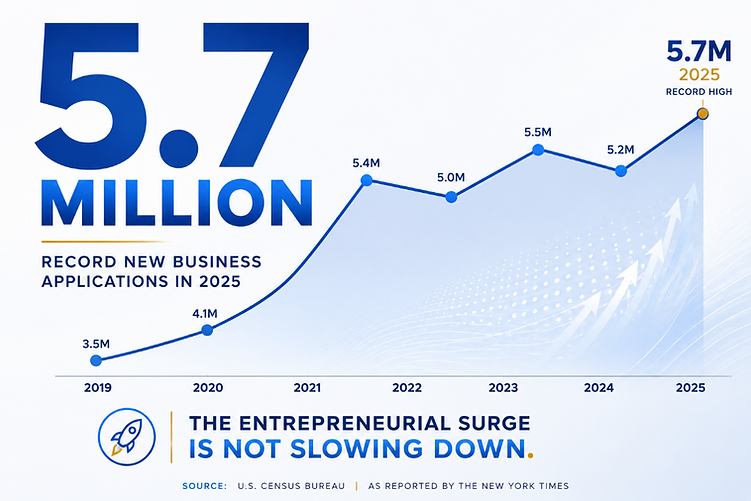
In 2025, Americans filed 5.7 million applications to start new businesses, the highest number recorded in the two decades that the U.S. Census Bureau has tracked the data. And the momentum has continued into the first half of 2026. After decades of concern about declining entrepreneurial dynamism, the entrepreneurial spirit appears to be surging again.
The numbers are impressive. But I believe the more important question is why this is happening now.
We are living in what I have often described as a world of Permanent White Water.
The metaphor is simple. Imagine navigating a raft down a mountain river where the water never becomes calm. There is no quiet stretch ahead where we can finally return to business as usual. The currents keep shifting. New obstacles appear without warning. The speed increases. The route that worked yesterday may not work tomorrow.
That increasingly describes the environment facing entrepreneurs and SMEs.
A pandemic reshapes how and where we work. Supply chains are disrupted. Geopolitical tensions alter markets overnight. Technology advances at extraordinary speed. Artificial intelligence suddenly gives a single entrepreneur access to capabilities that once required an entire organization.
The water does not calm.
And perhaps the extraordinary rise in entrepreneurship is telling us something important: people are no longer simply waiting for it to calm.
From Disruption to Creation
The recent entrepreneurial surge began during the pandemic, when layoffs, remote work, government support, low interest rates, and changing personal priorities pushed many people to reconsider traditional employment and create businesses of their own. More recently, however, another force appears to be accelerating the movement: artificial intelligence.
Nearly 60 percent of founders surveyed by Gusto who started businesses in 2025 said they used AI, and half reported that it allowed them to start faster and at lower cost. AI tools are increasingly functioning as virtual collaborators—helping entrepreneurs research markets, develop communications, create marketing, answer questions, perform tasks, and write code.
This changes the economics of entrepreneurship.
For generations, one of the greatest barriers to starting a business was access to resources. You needed capital. You needed specialized knowledge. You needed employees. You needed infrastructure.
AI does not eliminate these needs, but it is beginning to dramatically lower some of these barriers.
A single entrepreneur can now access capabilities that once belonged primarily to larger organizations. The New York Times article points to evidence of a rise in solo entrepreneurs who may be using AI to perform work that previously required human employees. Business applications have also surged in sectors with high exposure to AI, including information and professional, scientific, and technical services.
This may represent more than another startup boom.
We may be witnessing the emergence of a different architecture of entrepreneurship.
Entrepreneurship Was Made for White Water
Permanent White Water is usually discussed as a challenge. But entrepreneurship gives us another way to look at it. Dr. Tarabishy wrote an article about this (Click Here).
Entrepreneurs do not require certainty before they act. They see changing currents and adjust. They identify opportunities created by disruption. They experiment, learn, adapt, and move.
The extraordinary rise in business applications may therefore reflect something deeper than economic conditions alone. In an environment where traditional structures feel less permanent and technology is placing powerful new capabilities directly into the hands of individuals, entrepreneurship itself may be becoming a way of navigating Permanent White Water.
But we should be careful about celebrating the numbers without asking what comes next.
A business application is not yet a sustainable enterprise. The available data still leaves open the question of how many applications will become operating companies, create employment, and survive over time.
There is another important signal in the data. Much of the increase in applications is being driven by businesses that are less likely to hire employees.
That raises a much bigger set of questions.
What does it mean for our economies if we create millions more entrepreneurs but fewer employers?
What happens to our traditional definition of an SME when one person, supported by AI, can operate with capabilities that once required ten or twenty people?
Does AI democratize entrepreneurship by giving more people the tools to participate—or does it create a new divide between those who can harness these technologies and those who cannot?
And perhaps most importantly, as AI gives entrepreneurs extraordinary new capabilities, how do we ensure that entrepreneurship remains centered on human beings?
The Conversation We Need Now
These are exactly the questions we need to be asking as entrepreneurs, researchers, policymakers, financial institutions, and ecosystem leaders come together for the SME World Forum in Paris, October 21–23, 2026.
The challenge before SMEs is no longer how to survive one disruption and return to stability.
There may be no return to stability.
The challenge is learning how to build, lead, finance, and grow businesses when change itself is permanent.
That requires new technologies, but technology alone will not be enough. It requires entrepreneurial orientation—the willingness to innovate, act proactively, and take calculated risks. But it also requires something equally important: keeping people at the center of the decisions we make about technology and growth.
The 5.7 million applications are therefore more than an economic statistic.
They may be a signal.
A signal that in an age of Permanent White Water, millions of people are choosing not simply to endure disruption, but to build through it.
The entrepreneurial surge is real.
Now we must ask what kind of enterprises—and what kind of future—we want it to create.
That is a conversation worth bringing to Paris.
Join the Conversation in Paris
The SME World Forum brings together entrepreneurs, researchers, policymakers, and SME leaders in Paris, October 21–23, 2026. Be part of the conversation about entrepreneurship, AI, and the future of SMEs.
Source & Further Reading: Sydney Ember, "America's Enterprising Spirit Is Booming After Decades-Long Slump," The New York Times, July 17, 2026. This article is original commentary inspired by and referencing reported data; it does not reproduce the original source material.